
Cost Segregation for Arizona Vacation Rental Owners
If you own a vacation rental property in Arizona, you may be leaving significant tax savings on the table.
Cost segregation is an IRS-approved tax strategy that allows property owners to identify and accelerate depreciation on certain components of a property. Instead of depreciating everything over the standard 27.5-year residential schedule, qualifying components can potentially be depreciated over much shorter periods—creating substantially larger deductions in the early years of ownership.
For owners of luxury short-term rentals in Scottsdale, Paradise Valley, Mesa, and across the Phoenix metro, the potential deduction can be significant.
The amount varies based on factors such as the property’s purchase price, improvements, furnishings, and other qualifying costs. For higher-value properties with substantial renovations, the accelerated deduction can reach hundreds of thousands of dollars.
For example:
One vacation rental owner purchased a property for approximately $1.67 million and subsequently invested roughly $1 million in improvements, bringing their total investment to approximately $2.67 million.
Through cost segregation and accelerated depreciation, they are able to deduct more than $1 million against income—dramatically accelerating the tax benefits associated with their investment.
Your results will depend on your specific property, improvements, tax situation, and eligibility, but the potential can be far greater than a few thousand dollars in annual savings.
If you own a high-value Arizona vacation rental, it may be worth having the property analyzed before assuming you're limited to traditional depreciation.
What Is Cost Segregation?
When you purchase a vacation rental, the IRS requires you to depreciate the building (not the land) over 27.5 years. That means on a $750,000 property with $550,000 in depreciable basis, you'd only deduct about $20,000 per year.
A cost segregation study is an engineering-based analysis that identifies components of your property that qualify for much shorter depreciation timelines: 5, 7, or 15 years instead of 27.5. These reclassified components typically include things like:
5-Year Property Furniture, appliances, lighting fixtures, ceiling fans, decorative finishes, cabinetry, window treatments, and specialty flooring
7-Year Property Office furniture, security systems, and certain equipment
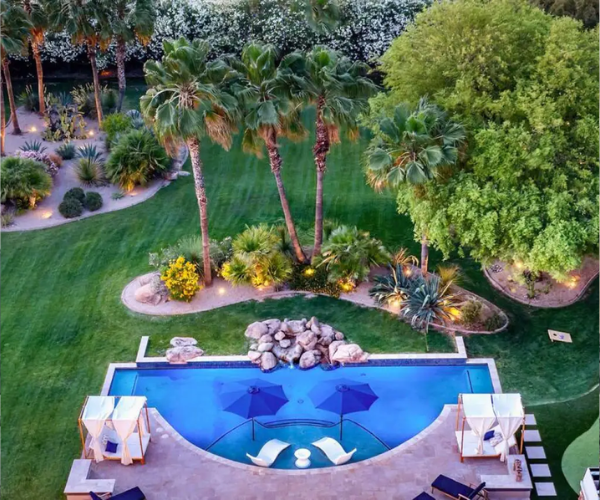
15-Year Property (Land Improvements) Swimming pools, outdoor kitchens, landscaping, driveways, patios, putting greens, sport courts, fencing, irrigation systems, and exterior lighting
For Arizona vacation rentals, especially luxury properties in Scottsdale and Paradise Valley, land improvements and high-end interior finishes often represent 20–40% of the total property value. That's a significant chunk that can be written off much faster than most owners realize.
Why This Matters Now: 100% Bonus Depreciation Is Back
The One Big Beautiful Bill Act, signed in July 2025, permanently restored 100% bonus depreciation for qualifying property placed in service after January 19, 2025. This reversed the phase-down that would have dropped bonus depreciation to just 20% in 2026.
What this means for you: every dollar identified through a cost segregation study in the 5, 7, and 15-year categories can potentially be deducted in full in Year 1. For a Scottsdale vacation rental valued at $750,000, that could mean $150,000–$300,000 in accelerated deductions available immediately.
Arizona's Tax-Friendly Environment
Arizona is one of the most favorable states in the country for vacation rental investors from a tax perspective.
Low flat state income tax. Arizona's flat 2.5% state income tax rate is among the lowest of any state that actually imposes an income tax.
Full federal conformity. Unlike California, which does not recognize bonus depreciation at the state level, Arizona fully conforms to federal depreciation rules. That means both your federal and state returns reflect accelerated deductions in Year 1 with no extra complications.
Low property tax rates. Arizona's average effective property tax rate sits around 0.43–0.62%, well below the national average.
For investors relocating from high-tax states like California, New York, or Washington, the combination of Arizona's tax structure and cost segregation benefits can be especially powerful.
The 7-Day Rule: Why Vacation Rentals Get Special Treatment
This is where short-term rentals have a distinct advantage over traditional long-term rentals.
If your property maintains an average guest stay of 7 days or fewer (which most Scottsdale and Phoenix vacation rentals do), the IRS does not classify it as a passive rental activity. Instead, it's treated as a trade or business.
This reclassification is significant because it means that if you materially participate in managing your short-term rental, the depreciation losses generated by a cost segregation study can offset your W-2 wages, 1099 income, or other active income. Traditional long-term rentals face passive activity loss limitations that prevent this.
For high-income professionals, executives, and business owners with Arizona vacation rental properties, this creates a powerful tax planning opportunity.
Material participation generally requires that you spend more than 100 hours per year on rental activities and that no one else spends more time than you do. Activities can include communicating with guests, coordinating maintenance, overseeing cleanings, managing bookings, reviewing financials, and making property improvement decisions.
What Does a Cost Segregation Study Look Like?
The process is relatively simple for the property owner:
1. Initial consultation. A cost segregation provider reviews your property details, purchase price, and tax situation to estimate potential savings.
2. Engineering analysis. Using property records, photos, and virtual or in-person walkthroughs, engineers identify and categorize every reclassifiable asset in your property.
3. Detailed report. You receive a comprehensive, engineering-based report that your CPA uses to apply the accelerated depreciation on your tax return.
4. Tax filing. Your CPA integrates the cost segregation findings into your return. For properties you've owned for multiple years, a "look-back" study using IRS Form 3115 lets you claim a one-time catch-up deduction for all previously missed accelerated depreciation, applied to your current tax year without needing to amend prior returns.
Studies typically cost between $2,000 and $5,000 depending on property complexity, and they often pay for themselves many times over in Year 1 tax savings alone.
Who Benefits Most?
Cost segregation is especially valuable for Arizona vacation rental owners who fit one or more of these profiles:
Recent purchasers. You bought a property in the last 1–3 years and have been using standard straight-line depreciation. A study can reclassify assets retroactively.
High-value properties. Properties with a depreciable basis (purchase price minus land value) of $200,000 or more are strong candidates. Scottsdale luxury rentals in the $750K–$1.5M range with pools, outdoor kitchens, and designer finishes tend to produce the largest absolute deductions.
High W-2 earners. If you materially participate in your STR and earn significant income from employment or a business, cost segregation losses can directly offset that income.
Renovation investors. If you've recently renovated or upgraded a property (new pool, remodeled kitchen, added outdoor entertainment areas), the improvement costs can be analyzed separately for additional accelerated deductions.
Owners who've never had a study done. Even if you've owned your property for years, a look-back study can capture all the accelerated depreciation you've been missing in a single tax year.
Arizona Vacation Rental Features That Qualify
Arizona properties, particularly in the luxury Scottsdale and Paradise Valley markets, tend to be rich with re-classifiable assets. Common features in our market that are strong candidates for shorter depreciation schedules include:
Resort-style swimming pools and spas
Outdoor kitchens and built-in BBQ areas
Putting greens and sport courts
Fire pits and outdoor fireplaces
Custom landscaping and desert hardscaping
Artificial turf
Specialty lighting (interior and exterior)
Home automation systems (smart locks, thermostats, security cameras, noise monitoring)
High-end flooring (tile, stone, hardwood)
Designer cabinetry and countertops
Built-in entertainment systems
Water features and splash pads
Covered patios and pergolas
Driveways and decorative walkways
Fencing and privacy walls
Irrigation systems
Many of these features are standard in Arizona's luxury vacation rental market, which is why cost segregation studies tend to produce particularly strong results for properties in this region.
Important Considerations
Depreciation recapture. When you eventually sell a property on which you've taken accelerated depreciation, you'll face recapture tax on the difference between accelerated and straight-line depreciation at ordinary income rates. This doesn't eliminate the benefit (the time value of money and years of deferred taxes still work in your favor), but it's something to plan for with your CPA.
1031 exchanges. If you plan to sell and execute a 1031 exchange, cost segregation benefits carry forward into the replacement property, deferring recapture. Learn more about 1031 exchanges for vacation rental investors →
This is not tax advice. Every property and tax situation is unique. We strongly recommend working with a qualified CPA or tax advisor who understands short-term rental taxation to determine how cost segregation fits your specific financial picture.
Talk to Someone Who Understands the Arizona STR Market
At List My Rental Home, we work with luxury vacation rental owners across Scottsdale, Paradise Valley, Phoenix, Mesa, and beyond. We see firsthand how properties perform, what drives revenue, and how smart investors structure their portfolios for maximum return.
While we don't perform cost segregation studies ourselves, we partner with property owners who are serious about treating their vacation rental as a real investment. If you have questions about the Arizona short-term rental market, property performance expectations, or how to position your property for both revenue and tax efficiency, we're happy to talk.